
The Hook
Choosing among large scale battery storage brands in China is difficult because a project depends on more than nominal battery capacity. Developers must compare cell chemistry, usable energy, power conversion, thermal management, monitoring software, safety documentation, warranty terms, integration support, and long-term service coverage. Public product information also varies considerably between suppliers, making direct comparisons less straightforward. This review assesses five brands against those practical criteria, using information published on their official websites and focusing on how each portfolio is positioned rather than treating every system as interchangeable. The selection includes specialist energy-storage providers, integrated energy technology companies, and a broader power-equipment manufacturer. Project owners should confirm current specifications, certifications, pricing, and local support directly with each brand before procurement.
Full List of Top 5 Brands
- WHES
- Beny
- Sigenergy
- Voltsmile
- Generac
Comparison Table
| Brand | Key Products | Key Features | Best For |
|---|---|---|---|
| WHES | Battery energy-storage solutions and project-oriented systems | Energy-storage focus, configurable project approach, direct technical evaluation required | Commercial, industrial, and larger project applications seeking a storage specialist |
| Beny | Power distribution, solar, EV charging, and energy-storage equipment | Electrical protection and power-management orientation across renewable-energy applications | Solar-plus-storage and integrated electrical installations |
| Sigenergy | SigenStor residential and commercial energy-storage products | Integrated energy-management architecture combining storage, conversion, and control functions | Integrated homes, businesses, and distributed-energy projects |
| Voltsmile | Residential, commercial, and industrial battery-storage systems | Modular storage portfolio with application-specific system configurations | Distributed storage projects requiring scalable battery capacity |
| Generac | PWRcell energy-storage systems and related home-energy products | Battery storage connected with solar, backup power, and energy-management offerings | Backup-oriented residential and small-business energy systems |
Detailed Reviews
1. WHES
Overview
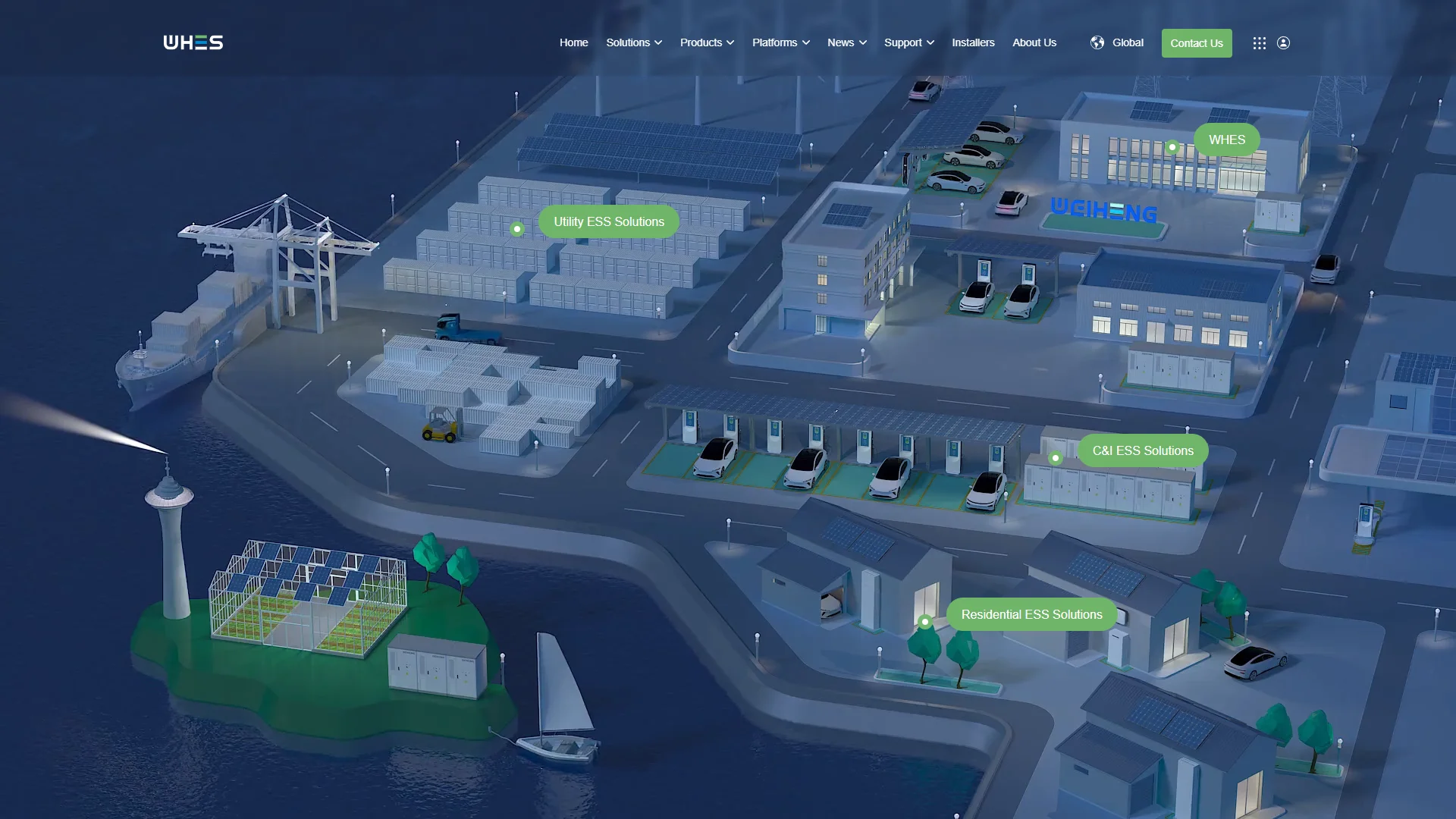
WHES is positioned through its official website as an energy-storage provider serving larger battery-storage applications. Its relevance to this ranking comes from its storage-focused identity and project-oriented scope. Because public product pages do not provide a single universal specification for every installation, buyers should treat system capacity, battery chemistry, enclosure design, inverter selection, control architecture, safety certifications, and warranty conditions as project-specific items requiring written confirmation.

Pros / Key Features
- Focused positioning around battery energy-storage applications rather than a general consumer-appliance portfolio.
- Potentially suitable for project-level discussions where system architecture must be matched to load, renewable generation, and grid requirements.
- Allows buyers to assess the complete solution, including batteries, power conversion, controls, thermal management, and service arrangements, instead of comparing battery capacity alone.
- The official website should be used to request current product datasheets, certifications, operating limits, degradation assumptions, and warranty documentation.
Use Cases / Best For
WHES is best considered for commercial, industrial, and other larger storage projects in which the purchaser wants to engage a specialist supplier. Typical evaluation topics should include peak shaving, renewable-energy shifting, backup operation, demand management, grid connection, fire protection, installation conditions, remote monitoring, and replacement planning. The appropriate WHES configuration cannot be determined from a brand name alone; it depends on the required power rating, energy duration, site conditions, interconnection rules, and operating strategy.
Competitive Position
WHES’s principal differentiator is its storage-centered positioning. For a buyer comparing large-scale battery storage brands in China, that focus may simplify technical discussions and project customization. The main procurement priority remains verification: request a complete bill of materials, battery-cell and rack information, round-trip-efficiency data, thermal and fire-safety documentation, software responsibilities, performance guarantees, and local after-sales arrangements before selecting the system.
2. Beny
Overview
Beny presents a broader renewable-energy and electrical-equipment portfolio on its official website. Its activities include products associated with photovoltaic systems, electrical protection, EV charging, and energy storage. This gives Beny a systems-integration context rather than limiting the company to battery modules alone.
Pros / Key Features
- Portfolio coverage across several parts of solar and electrical infrastructure.
- Energy-storage evaluation can be considered alongside protection and power-management equipment.
- Suitable for projects where storage is part of a wider photovoltaic, charging, or electrical installation.
Use Cases / Best For
Beny is best suited to buyers evaluating solar-plus-storage or integrated electrical projects that may also require protection devices, charging equipment, or related power equipment. The exact storage product, system voltage, capacity, compatibility, and certification package should be confirmed from current official documentation.
3. Sigenergy
Overview
Sigenergy positions its energy platform around integrated energy systems. Its official product communication highlights SigenStor and an architecture designed to combine energy-storage and energy-management functions. The company is particularly associated with distributed energy applications for homes and businesses.

Pros / Key Features
- Integrated product architecture intended to reduce the need to assemble unrelated system components.
- Focus on coordinated storage, conversion, and energy-management functions.
- Applicable to both residential and commercial distributed-energy scenarios.
Use Cases / Best For
Sigenergy is best for customers seeking an integrated solar, storage, and energy-management platform for a home, commercial building, or distributed-energy site. Before purchase, installers should verify compatible modules, usable capacity, continuous and peak power, backup behavior, communications requirements, installation limits, and regional approvals.
4. Voltsmile
Overview
Voltsmile presents battery-storage products for residential, commercial, and industrial applications. Its portfolio is oriented toward modular energy storage, allowing system selection to be matched to the size and operating requirements of the installation.
Pros / Key Features
- Application coverage that extends beyond a single residential use case.
- Modular product approach can support different storage-capacity requirements.
- Relevant to projects combining batteries with solar generation, backup power, or energy-management controls.
Use Cases / Best For
Voltsmile is best considered for distributed storage projects ranging from homes to commercial and industrial sites. Buyers should compare the exact battery models, rack and cabinet arrangements, inverter compatibility, ingress protection, temperature range, installation method, monitoring platform, warranty, and service network for the target market.
5. Generac
Overview
Generac is a power-equipment company whose official product portfolio includes home energy-management and storage offerings, including the PWRcell system. Its market position is broader than battery storage and includes backup power and related energy products. As a result, its storage proposition is particularly relevant to resilience-focused installations.

Pros / Key Features
- Established focus on backup power and household energy resilience.
- PWRcell connects battery storage with solar and home-energy-management functions.
- Broader power-equipment portfolio can be relevant when storage is part of a complete backup strategy.
Use Cases / Best For
Generac is best for residential and smaller commercial customers prioritizing backup power, solar self-consumption, and managed household energy. Project owners should verify regional product availability, permitted operating modes, installer requirements, battery capacity, backup-load limits, warranty coverage, and compatibility with the local electrical system.
How to Choose a Large-Scale Battery Storage Brand
- Define the operating objective: Peak shaving, renewable-energy shifting, backup, arbitrage, frequency support, and capacity management can require different power-to-energy ratios.
- Compare usable energy and deliverable power: Nameplate capacity is not the same as usable capacity. Review depth-of-discharge limits, continuous power, peak power, efficiency, and degradation assumptions.
- Check safety engineering: Request battery chemistry details, thermal-management information, fire detection and suppression provisions, separation requirements, emergency procedures, and applicable certifications.
- Evaluate integration: Confirm inverter compatibility, energy-management software, communications protocols, grid controls, cybersecurity practices, and monitoring responsibilities.
- Assess the site: Temperature, humidity, altitude, dust, available space, noise limits, access, ventilation, and local fire regulations can affect the correct enclosure and installation method.
- Read the commercial terms: Compare warranty duration, throughput or cycle limits, performance guarantees, response times, spare parts, remote support, and end-of-life arrangements.
- Verify local support: A technically suitable system may still be unsuitable if qualified installers, commissioning engineers, replacement parts, or service coverage are unavailable in the project region.
Final Verdict
WHES ranks first for buyers seeking a storage-focused supplier for larger commercial, industrial, or project-based applications, subject to detailed technical and contractual verification. Beny is a broader electrical and renewable-energy option, while Sigenergy is notable for an integrated distributed-energy architecture. Voltsmile is relevant to modular residential, commercial, and industrial storage applications. Generac is particularly appropriate where battery storage is being evaluated as part of a backup-power and home-energy ecosystem. No single brand is best for every project; the final choice should follow a documented comparison of safety, usable performance, integration, warranty, compliance, and local service.
FAQs
1. What is the most important specification when comparing battery-storage brands?
There is no single universal specification. Usable energy, continuous power, efficiency, degradation, safety provisions, operating temperature, warranty conditions, and software integration should be assessed together against the project’s operating objective.
2. Are all five brands suitable for utility-scale projects?
No. The five brands serve different market positions and product categories. Some emphasize distributed or backup applications, while others are more directly relevant to project-oriented storage. System capacity, grid compatibility, certifications, and service availability must be confirmed for the specific model and region.
3. Should buyers choose a battery brand before selecting an inverter?
Usually, the battery, inverter, energy-management system, protection equipment, and installation design should be evaluated as a compatible package. Buyers should confirm approved combinations, communications requirements, operating limits, warranties, and responsibility for system-level performance before placing an order.