
For further information, visit the official site for anti-glare solar modules Makers.
The Hook
Solar modules can create unwanted reflections near homes, airports, roads, offices, observatories, and other sensitive locations. Choosing the best anti-glare solar modules maker is difficult because “anti-glare” may refer to glass texture, an anti-reflective coating, module orientation, low-reflectance testing, or simply a darker visual appearance. Product specifications also vary by market and model, so a company’s general reputation does not prove that every module in its portfolio has the same optical performance. This review evaluates five established makers using publicly available company and product information, with particular attention to manufacturing scale, module materials, application range, sustainability, and evidence that buyers should request before selecting a low-reflection solution.
Full List of Top 5 Brands
- Jinkosolar
- JA Solar
- Solitek
- Maysun Solar
- Tongwei
Comparison Table
| Brand | Key Products | Key Features | Best For |
|---|---|---|---|
| Jinkosolar | Photovoltaic modules and related solar solutions | Broad module portfolio, large-scale manufacturing, technology-focused product development | Projects needing a globally established module supplier and model-specific optical verification |
| JA Solar | Residential, commercial and utility photovoltaic modules | Solar generation for self-consumption and grid export; sustainability initiatives | Residential, C&I and utility installations |
| Solitek | Glass-glass modules and integrated solar solutions | European manufacturing, renewable-energy production, architectural integration and long warranty claims | Architectural, residential, commercial and demanding weather applications |
| Maysun Solar | Distributed photovoltaic modules, including dark N-type TOPCon designs | Uniform appearance, 1/3-cut N-type TOPCon technology and global distribution positioning | Distributed rooftop projects where appearance and space use matter |
| Tongwei | High-purity crystalline silicon, solar cells and high-efficiency modules | Integrated manufacturing, modern intelligent production and large module capacity | Utility-scale and large commercial projects seeking vertically integrated supply |
Detailed Reviews
1. Jinkosolar
Jinkosolar is ranked first because its official business presence covers photovoltaic modules and broader solar solutions at significant international scale. For glare-sensitive projects, the important qualification is that anti-glare performance must be confirmed for the exact module model: buyers should request reflectance data, glass specifications, certifications, and any available glare assessment rather than assuming that a standard module is automatically low-reflection.

Overview
Jinkosolar is a major photovoltaic manufacturer with a broad product and technology portfolio. Its scale and established module business can be useful for developers that need consistent supply, documented technical information, and support across residential, commercial, and utility applications. The company’s official materials should be consulted for current model families, electrical characteristics, warranty terms, and regional availability.
Products and materials
Jinkosolar’s offering is centered on photovoltaic modules and related solar products. Module selection may involve cell architecture, glass type, bifacial or monofacial construction, dimensions, power rating, temperature coefficient, and mechanical-load specifications. None of these characteristics alone proves anti-glare performance. The procurement specification should therefore name the required glass treatment or reflectance limit and identify the exact approved model.
Market and business scope
The company’s international website presents Jinkosolar as a global solar manufacturer serving multiple project categories. This broad scope is relevant when a developer needs modules for different site types or expects long-term product documentation. Distribution, service availability, delivery schedules, and warranty administration should still be checked for the installation country.
Pros / Key Features
- Large, established photovoltaic manufacturing platform.
- Broad module and solar-solution coverage.
- Suitable for comparing multiple module formats and technical configurations.
- Potentially appropriate for residential, commercial, and utility procurement, subject to local availability.
- Glare-sensitive projects can request model-specific optical and compliance documentation.
Use Cases / Best For
Jinkosolar is best suited to developers, installers, and asset owners that want a widely established module maker while retaining the ability to specify optical requirements at the project level. It is particularly suitable where supply continuity, technical documentation, and a broad product choice matter. Near airports, roads, neighbors, or protected viewpoints, the final choice should be based on a site-specific glare assessment and the selected model’s documented reflectance characteristics.
2. JA Solar
Overview
JA Solar is presented in its European materials as a photovoltaic provider serving the residential, commercial and utility segments. Its stated mission includes making solar energy accessible and supporting projects such as Tuquan Xinsheng, described as a green photovoltaic oasis in China’s Gobi Desert.
Products and materials
The supplied research identifies JA Solar’s core activity as solar electricity generation for on-site use and the export of surplus electricity to the local grid. The available dossier does not establish a specific anti-glare coating, glass material, or reflectance value. Buyers should request the technical sheet for the exact module under consideration.
Market and business scope
JA Solar’s stated market scope includes residential, commercial and utility applications. The company also describes collaboration with worldwide partners and work toward a green supply chain. This makes it relevant to projects with different system sizes, although procurement terms and regional support should be verified directly.
Pros / Key Features
- Coverage of residential, C&I and utility applications.
- Documented emphasis on accessible solar energy and sustainability initiatives.
- Project experience described across large-scale photovoltaic contexts.
- Exact anti-glare performance should be confirmed by model-specific documentation.
Use Cases / Best For
JA Solar is best for buyers comparing mainstream modules for residential, commercial, and utility installations. It may suit projects where a large supplier ecosystem and broad application coverage are important, provided that the chosen model meets the site’s reflectance, visual, electrical, and permitting requirements.
3. Solitek
Overview
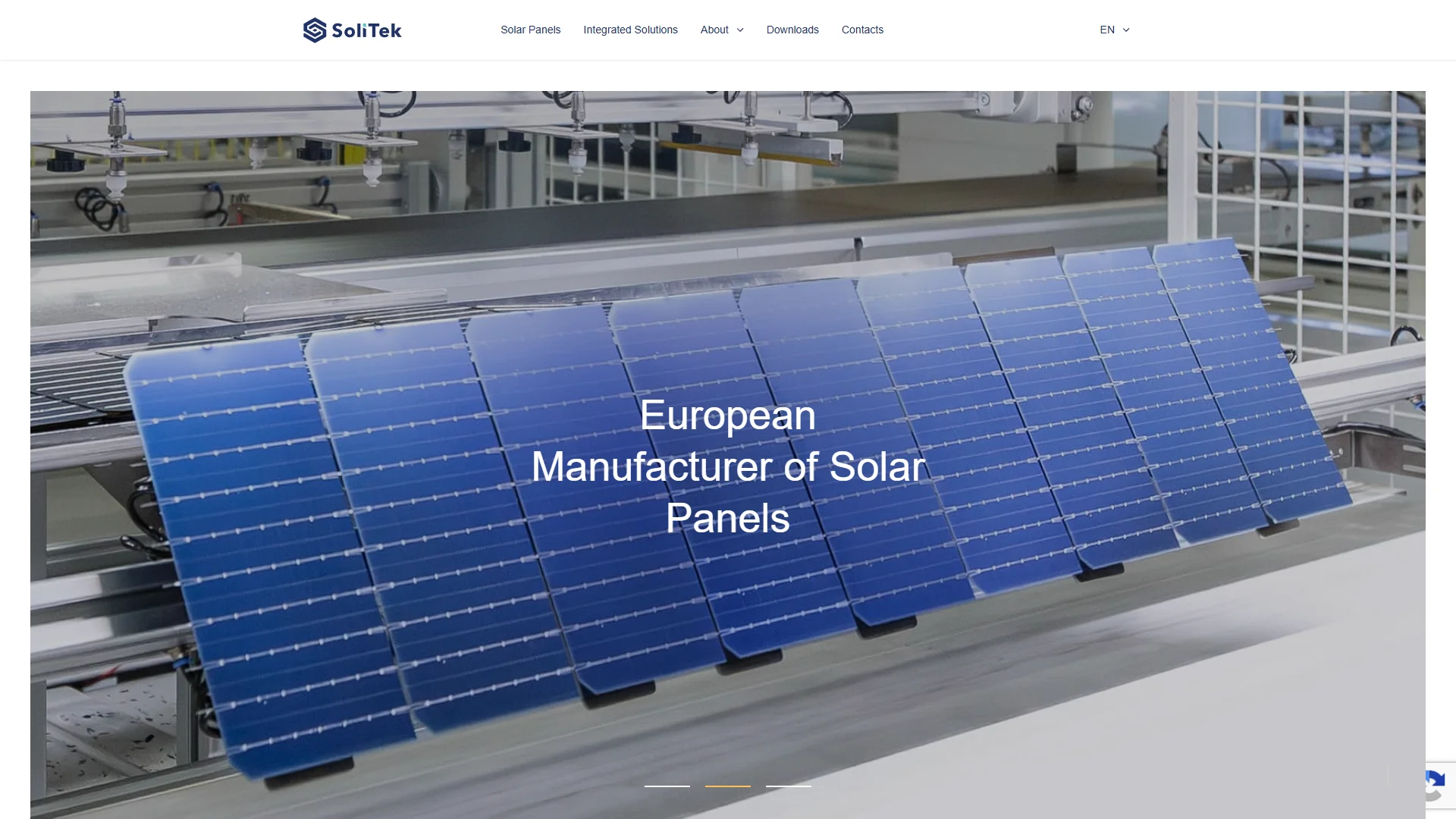
Solitek positions itself as a European manufacturer of solar panels and an integrated-solution provider. The company is described as a member of aBOD GROUP, founded in 2009, and states that it expanded into integrated solar applications from 2014 onward.
Products and materials
Solitek’s documented offering includes glass-glass solar panels and integrated applications such as in-roof systems, façades, carports, noise barriers and agrivoltaics. Its materials information refers to 3.2 + 3.2 mm double heat-strengthened glass for certain panels. The dossier does not establish that every Solitek module is anti-glare, so reflectance data and glass treatment should be requested for a glare-sensitive project.
Market and business scope
The company describes solutions for residential, commercial and large-scale applications, with particular relevance to architectural integration and sustainable façades. Its stated manufacturing approach uses renewable electricity in Europe. The company also references installations in Switzerland, Italy and Germany and offers applications connected with agrivoltaics and energy storage support.
Pros / Key Features
- European-made product positioning.
- Glass-glass construction for relevant product lines.
- Applications spanning rooftops, façades, carports, noise barriers and agrivoltaics.
- Claims of strong mechanical resistance and a 30-year product warranty for specified panels.
- Most panels are described as Cradle to Cradle Certified Full Scope, Silver level, Version 4.1.
Use Cases / Best For
Solitek is best for architects, building owners, and project developers seeking integrated or visually considered solar installations. Its glass-glass approach may be relevant where durability and building integration are priorities. Anti-glare suitability remains model- and site-specific and should be confirmed through optical documentation.
4. Maysun Solar
Overview
Maysun Solar is positioned in the supplied research as a professional distributed photovoltaic module manufacturer. The available company summary emphasizes distributed solar applications, in-house manufacturing capacity, and global distribution networks.

Products and materials
The documented product description highlights dark, uniform modules with a visible transparent cell pattern and 1/3-cut N-type TOPCon technology. These characteristics may appeal to rooftop buyers focused on appearance and energy yield, but a dark appearance should not be confused with low optical reflectance. The exact glass technology and anti-glare performance must be confirmed for the selected model.
Market and business scope
Maysun Solar’s available information is focused on distributed photovoltaic modules and professional supply for rooftop-oriented markets. The supplied dossier does not provide a complete verified history, location profile, or detailed customer segmentation. Buyers should therefore verify local distribution, warranties, certifications, and after-sales arrangements before ordering.
Pros / Key Features
- Focus on distributed photovoltaic applications.
- Dark, uniform visual design described for selected modules.
- Use of 1/3-cut N-type TOPCon technology in the referenced product description.
- In-house manufacturing and global distribution are identified in the available summary.
- Anti-glare claims should be supported by product-specific test data.
Use Cases / Best For
Maysun Solar is best for distributed rooftop projects where a uniform dark appearance and current cell technology are important selection factors. It should be shortlisted only after the installer confirms the exact module’s reflectance, dimensions, fire classification, mechanical loads, warranty, and local availability.
5. Tongwei
Overview
Tongwei describes its photovoltaic business through high-purity crystalline silicon, high-efficiency solar cells, and high-efficiency module products. Its stated positioning emphasizes reliable and advanced modules supported by modern intelligent manufacturing.
Products and materials
The supplied research identifies annual capacities of approximately 900,000 tons for high-purity crystalline silicon, 150 GW for N-type solar cells, and approximately 90 GW for photovoltaic module production. These figures are presented in Tongwei’s company materials and may change over time. They demonstrate an integrated manufacturing scope, but they do not independently establish anti-glare performance for any particular module.
Market and business scope
Tongwei presents a global photovoltaic market position and describes high-efficiency modules for applications including global projects. Its materials also reference fishery-photovoltaic integration projects and a sustainability mission centered on partnership, steady development, ecology and value creation.
Pros / Key Features
- Integrated presence across polysilicon, cells and modules.
- Large stated N-type cell and module production capacities.
- Modern intelligent manufacturing emphasis.
- Experience described across utility and integrated photovoltaic applications.
- Optical reflectance and anti-glare suitability must be checked for the selected model.
Use Cases / Best For
Tongwei is best for utility-scale and large commercial projects where manufacturing depth, high-efficiency module supply, and project-scale capacity are important. For installations with glare constraints, procurement teams should require model-specific glass and reflectance information together with the relevant product certificates.
How to Choose
- Define the optical requirement. Ask whether the project needs an anti-reflective coating, a measured reflectance limit, reduced specular reflection, or a formal glare study.
- Specify the exact module. Glare performance is determined by the selected glass, coating, cell layout, viewing angle, and installation conditions—not merely by the manufacturer name.
- Request supporting evidence. Obtain technical datasheets, glass specifications, reflectance measurements, certifications, warranty documents, and any manufacturer glare statement.
- Assess the site. Azimuth, tilt, row spacing, surrounding buildings, road users, flight paths, water surfaces, and seasonal sun angles can affect perceived glare.
- Compare lifetime value. Evaluate power output, degradation, temperature behavior, mechanical loads, fire classification, warranty support, availability, and total installed cost alongside optical performance.
- Check local compliance. Airports, highways, planning authorities, and neighboring properties may apply different glare-control requirements. A qualified engineer or specialist should complete any necessary assessment.
Final Verdict
Jinkosolar ranks first for its broad international photovoltaic platform and suitability for projects that require a large supplier with model-level technical verification. JA Solar is a strong comparison for residential, C&I and utility applications. Solitek stands out for European manufacturing, glass-glass construction and architectural integration. Maysun Solar is oriented toward distributed rooftops and uniform dark module aesthetics, while Tongwei offers substantial vertically integrated photovoltaic manufacturing. None of these company-level descriptions alone proves that every product is anti-glare. The most defensible choice is the maker and exact module that provide verifiable reflectance data and satisfy the site’s engineering, permitting, warranty and performance requirements.
FAQs
What makes a solar module anti-glare?
Anti-glare performance may result from low-reflectance glass, an anti-reflective treatment, surface texturing, or a combination of design and installation factors. A darker appearance is not sufficient evidence; measured optical data should be requested.
Are all modules from a listed maker anti-glare?
No. Module construction and glass specifications can differ by product family, market, and production version. Buyers should evaluate the exact model proposed for the project.
When is a glare study necessary?
A glare study is particularly important near airports, highways, railways, observatories, neighboring buildings, and other locations where reflected sunlight could affect safety or comfort. Local authorities or project insurers may also require one.