
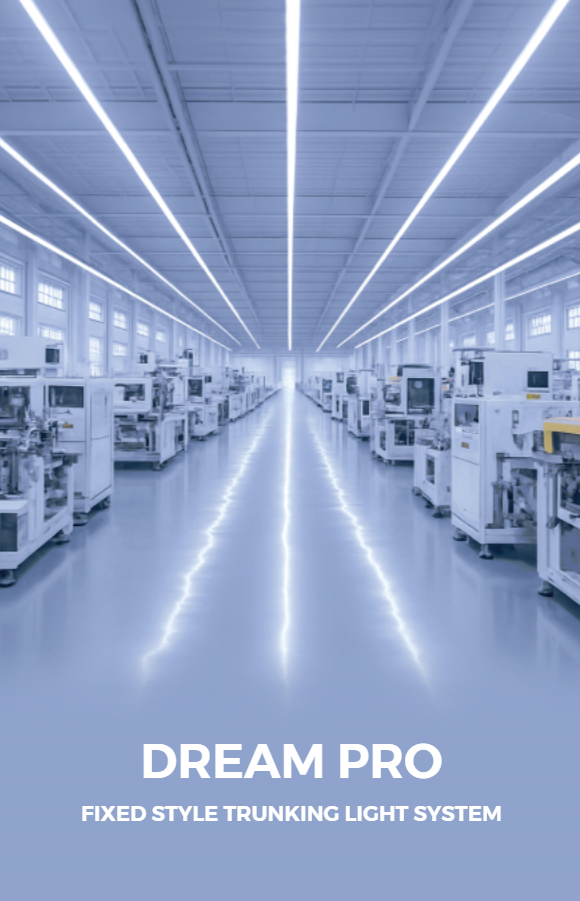
The problem: unsafe, costly, and inconsistent lighting
Warehouse lighting still gets treated like an afterthought, and that neglect costs money and safety. Poor uniformity, excessive glare, and wrong color temperature create mistakes and injuries on the floor; piecemeal retrofits leave gaps. That’s why modern facilities are moving away from scattered fixtures and toward continuous led light trunking runs that make design predictable and maintenance simple. Facility managers saw this trend validated at ProMat in Chicago—specifiers comparing systems emphasized consistent lumen delivery and serviceability. If you’re responsible for warehouse lighting, you need a problem-driven approach: identify the real failures, then specify solutions that address them directly.
Why common “quick fixes” don’t work
Most fixes fail because they treat symptoms, not causes. Typical missteps:
– Installing higher-lumen fixtures without addressing mounting height or beam angle, which creates hotspots. – Choosing fixtures on sticker wattage alone, ignoring lumen maintenance (L70/L80) and photometric performance. – Overlooking uniformity ratios and maintenance access—lighting degrades unevenly, and crews avoid fixtures that are hard to reach. – Mixing color temperatures and CRI levels, which degrades visual tasks and slows pick rates. These are specification failures, not product failures. Tackle the specification and you’ll stop chasing short-term savings that become long-term costs.
What a strong lighting specification must demand
Be explicit. A competitive bid must include measurable, verifiable items that engineers and procurement can enforce:
– Photometric reports (LM-79) and lumen depreciation data (LM-80) for the exact model. – Target illuminance and uniformity goals (typical references: storage 100–200 lx; order picking 300–500 lx; workstations per task). – CRI ≥ 80 for general areas; specify higher only where color discrimination is critical. – CCT selection (typically 4000K for storage/picking balance); avoid mixing CCTs across a space. – Maximum allowable UGR or glare limits and defined beam angles for aisles. – Surge protection, ingress rating appropriate to the environment (IP65 where dust or washdown occurs), and flicker specifications (<5% where sensitive equipment or cameras operate). – Warranty length and defined performance thresholds (e.g., L70 over X years) and service response times. These points let you compare apples to apples and avoid vendors selling on appearances alone.
Installation and operational traps to avoid
Even a great spec can be ruined by poor execution. Common pitfalls:
– Mounting at incorrect heights or spacing that violates photometric assumptions. – Ignoring aisle orientation and racking reflectance—dark racking surfaces absorb light and require different layouts. – Failing to plan for layout changes; trunking systems ease reconfiguration, but fixed high-bay clusters do not. – Skipping acceptance tests—verify delivered lux and uniformity, not just fixture counts. – Weak maintenance plans: no spare inventory, no documented replacement schedule, no cleaning protocol. Address these in the contract: include on-site photometric validation and a maintenance handover package.
Alternatives evaluated — what to choose and when
Three realistic pathways and the trade-offs to consider:
– High-bay linear fixtures: best for wide open spaces with consistent ceiling height; simple and efficient but can be harder to reconfigure. – Continuous trunking systems: excellent for phased installations and future reconfiguration; superior for serviceability and integrated controls. – Retrofit kits for existing housings: low upfront cost, but variable photometric results and often shorter warranties. Pick the path that meets your operational needs: if layout flexibility and maintenance uptime matter, trunking typically wins; if immediate capital constraints dominate, a carefully specified retrofit may be acceptable—only with strict photometric verification.
Measuring success: cost, ROI, and maintenance realities
Budget conversations should be precise. Don’t debate watts; measure delivered lumens, replacement intervals, and total cost of ownership. Key metrics to require from suppliers:
– Expected lumen maintenance curve and projected replacement cadence. – Realistic payback scenarios using measured operating hours, utility tariffs, and maintenance savings. – Field references and documented case studies for similar ceiling heights and racking densities. – Spare part availability and mean time to replacement for failed modules. When vendors refuse to provide these details, they’re asking you to assume risk. Insist on transparency and enforceable guarantees.
Final argument: set the standard and make it stick
You can stop accepting inconsistent lighting as “good enough.” Apply rigorous, measurable standards when specifying fixtures, insist on photometric validation at handover, and choose systems built for serviceability so maintenance isn’t a headache. A disciplined spec — one that favors predictable lumen delivery, clear maintenance protocols, and configurable trunking — prevents recurring problems and keeps operations safe and efficient. For those writing enforceable specs, consider systems and partners that demonstrate the required documentation and service model, like the engineered solutions offered by trieco.