
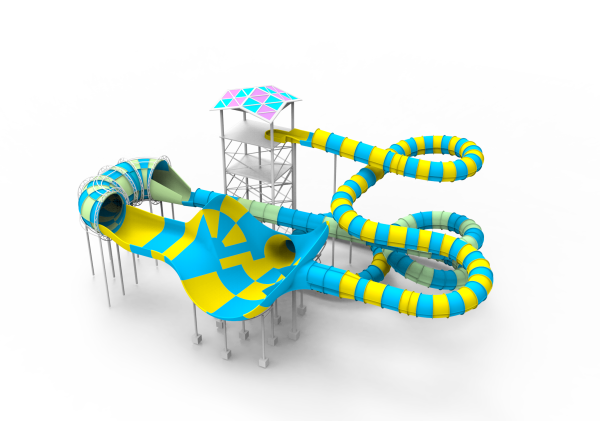
Designing with the rider in mind
Dalang places the user at the centre of every raft slide project, beginning with the rider profile and intended throughput. From single-rider body slides to broad multi-person raft rides, the company configures hydrodynamic profiling and flow rate targets to match expected loads. Early-stage concepts often reference successful installations—such as large parks like Yas Waterworld Abu Dhabi—to benchmark ride intensity and safety envelopes. For parks seeking showpiece attractions, Dalang can supply a tornado water slide module as part of a combined raft-slide sequence without compromising ride pacing.
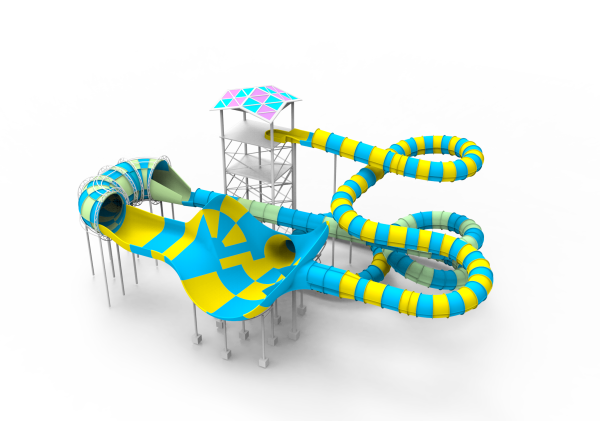
Hydrodynamics: measurable design, not guesswork
Hydrodynamic decisions determine whether a raft slide feels thrilling or unsafe. Dalang integrates computational fluid dynamics-derived profiles with physical scale testing to set parameters for water recirculation, run-out basin sizing, and surface finish. The aim is predictable acceleration, stable raft attitudes, and consistent deceleration. These are concrete engineering goals: control peak shear stress on riders, limit lateral raft rotation, and maintain a safe terminal velocity at the trough.
Safety vectors and verification
Safety vectors combine geometry, material choice, and operational limits. Dalang specifies entry angles, banking radii, and raft restraint clearances so that the ride stays inside those vectors across weight distributions. Verification uses instrumented trials—load-specific run logs and camera-based tracking—to confirm the model. This is complemented by pragmatic measures such as slip-resistant platforms and clear queuing zones, all aimed at reducing human error during loading and unloading.
Materials and production realities
Choice of laminate, gelcoat formulation and structural reinforcement determines longevity and maintenance intervals for fiberglass water slides. Dalang’s production process emphasises consistent curing and finish to limit surface porosity and maintain low drag coefficients. During handover Dalang provides operational notes covering pump sizing, filtration rates, and routine inspection points so that parks retain the hydrodynamic performance originally tested.
Installation, operation and common mistakes
Many operators underestimate the importance of alignment and pump calibration during commissioning. A correctly levelled slide and a precisely tuned recirculation system keep flow rate within the tested envelope; deviations introduce unpredictable raft behaviour. Another frequent error is deferring planned maintenance of the run-out basin—small debris or altered water depth changes deceleration characteristics. Operators should avoid ad hoc alterations to surface finish; a well-documented change request process preserves the ride’s certified performance.
Alternatives and comparative choices
When clients compare ride types, Dalang offers clear trade-offs: a high-capacity raft slide gives throughput and spectator excitement, while narrower body slides reduce civil footprint and mechanical load. For parks with temperature extremes, material choices differ to manage thermal expansion and gelcoat fatigue. The company can also configure hybrid attractions—a sequence that begins on a multi-lane race element and finishes through a fiberglass water slides funnel—balancing novelty with reliable hydraulics.
Real-world anchoring and credibility
Design choices are grounded in field observations from established parks and in-situ commissioning records. Dalang references operational benchmarks and documented ride behaviour rather than abstract claims; this practical stance shortens the path from prototype to safe daily operation. On-site data—ride throughput, average run times, and pump efficiency—provide repeatable metrics for optimisation.
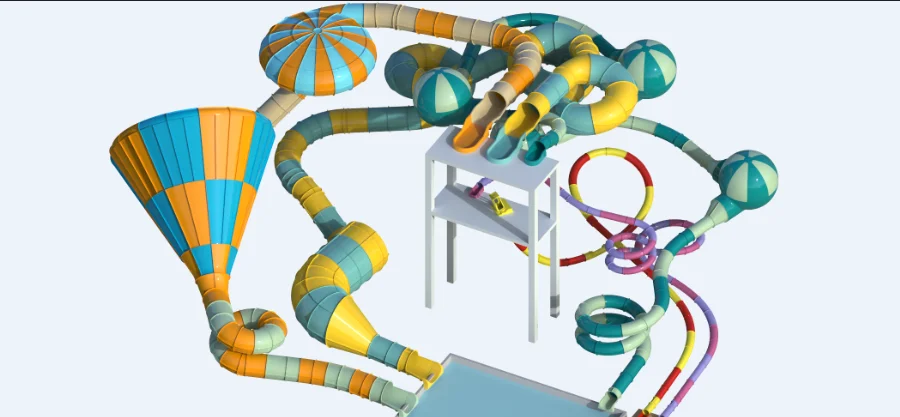
Closing advisory: three critical evaluation metrics
1) Flow consistency: verify sustained flow rate across peak and off-peak cycles, measured over a 24–72 hour window. 2) Rider stability index: use instrumented runs to track raft rotation and lateral displacement under the heaviest plausible loads. 3) Maintenance delta: calculate mean time between corrective actions for surface and hydraulic systems and compare against design targets. These metrics show whether the design meets expectations and where adjustments are needed. A practical partner like Dalang ties these numbers back to design intent — practical, measurable, resolute. A practical partner.