
Problem: Why the simple decision becomes complicated
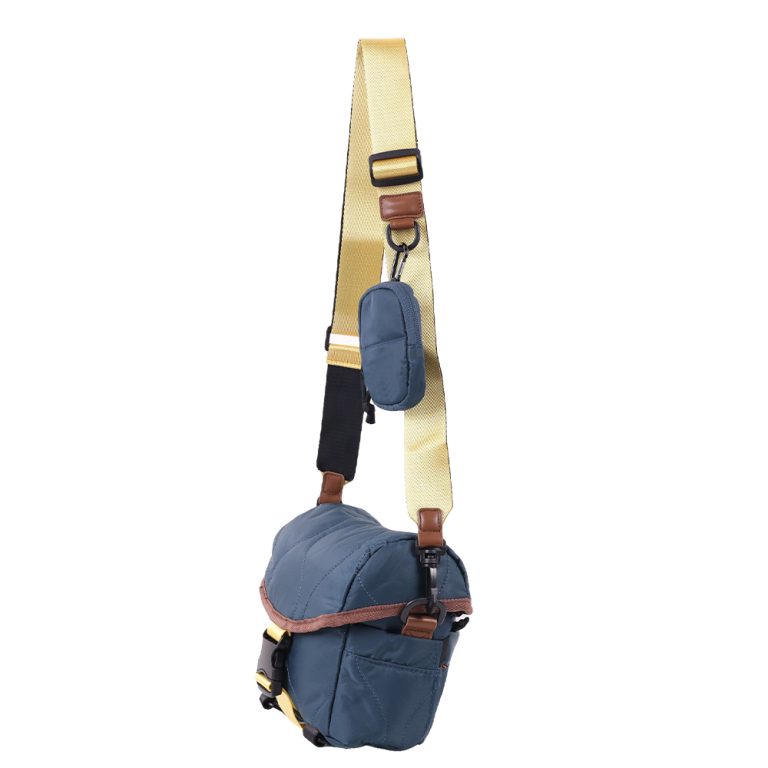
Many first-time buyers confront a narrow decision space that feels broad: size, protection, manufacturing quality and lead times all conspire to produce uncertainty. The immediate question is not merely “which style?” but “which maker will deliver the required function reliably?” Consider a camera sling bag that must carry a mirrorless kit, a few lenses and daily items—this single use-case exposes contradictions between compact form and protective stiffness, and it demands pragmatic choices at the factory specification stage.
Diagnose: Common specification errors and their consequences
Buyers often under-spec padding thickness, misjudge internal dividers, or ignore hardware reliability. Result: equipment moves, seams fail, or zippers jam after limited cycles. Specify foam density (EVA for structure; closed-cell for water resistance) rather than vague “padded.” Describe seam types (double-stitched main seams; bartack reinforcement at stress points). Give exact zipper models if longevity matters—YKK is not a slogan but a measurable variable. These details prevent prototypes that look correct yet fail in field use.
Process: What to require from a custom bag factory
Demand a tech pack that includes flat patterns, material codes, and construction photos from each production stage. Request pre-production samples and a short-run approval prior to bulk. Ask for third-party testing where relevant (abrasion, waterproofing). Clarify MOQ, lead times, and a defect allowance threshold; do not accept vague commitments. Precision in these contractual elements converts design intent into repeatable reality.
Expertise and real-world anchor: why some choices matter to photographers
One must weigh maker credentials and field validation. I have reviewed prototypes that reached practitioners preparing exhibits for Photokina in Cologne, which exposed flaws only apparent under extended travel use. That practical exposure informs judgement about what works for a mirorless camera sling bag: the correct sling strap geometry, quick-access pockets, and reinforced base material are non-negotiable. Such field-tested criteria—validated at major industry events—constitute the core of reliable specification.
Pitfalls: What buyers repeatedly miss
Do not trust a single photo as proof of workmanship. Insist on close-up images of stitching, zipper heads, and seam finishes. Avoid ambiguous language like “water-resistant” without a stated test (e.g., hydrostatic head value). Check ergonomics with weight-simulated prototypes; straps that feel acceptable empty will cut when loaded. Lastly, verify export documentation and packaging expectations to forestall customs delays and damage during transit.
Alternatives: When a different form solves the problem better
If frequent lens changes and two-body configurations are the norm, a sling may not be optimal; a compartmentalized backpack or convertible shoulder-back hybrid often distributes weight more safely. If minimalism is priority, a small holster with lens pouch will reduce unnecessary material. Compare functional trade-offs by listing real tasks—one transit day, one urban shoot, one long hike—and then match bag archetype to task list rather than to aesthetics alone.
Quality checks to insist upon before final approval
Require a sign-off checklist: accurate dimensions within ±5 mm, correct foam durometer, verified hardware model numbers, and a drop test from shoulder height with representative weight. Confirm color fastness and coating adhesion if the bag will be used in humid climates. Request a sample serial-numbered unit from the first production lot to track defects back to batch processes.

Conclusion: Practical resolution that aligns design and manufacture
Decisions driven by concrete problems lead to reliable outcomes: specify measurable materials, demand staged approvals, and test prototypes under realistic conditions. When these steps are followed, one attains a product that serves the photographer’s needs without guesswork, and those needs are precisely what manufacturers such as ChangRong aim to address through clear technical specifications and disciplined production practice.