

A Field Note From the Press Room
I was on a midnight rush in Long Beach last July, right off the 405, when the shop AC sputtered and the humidity spiked. DTF Film was rolling fine at 285°F for 12 seconds, then 32 of 180 transfers clung and scuffed—how do you explain that to a skate brand expecting boxes at 9 a.m.? After 15 years running B2B print supply and handling bulk film buys, I’ve learned it’s rarely the press tech at fault. It’s upstream: if your dtf film manufacturer skimps on release coating or anti-static, the powder cakes, the white underbase blooms, and you eat overtime (plus a hit to trust). I first felt that sting in 2016 on a 75µm PET hot-peel matte roll that squealed with static and welded itself to the next sheet—no fun, and not cheap. Here’s where the real leak starts, and how we plug it.

Why Standard Fixes Don’t Stick
Why do clean prints still lift?
Most shops tweak press temps, bump dwell time, or sift finer powder. Those moves help, but they ignore the root: coating uniformity and release speed. I’ve seen rolls with gorgeous clarity but uneven silicone laydown—microscopic valleys that grab molten adhesive. That’s why you get edge lift even when your PET base is rated “hot peel.” If the dyne level isn’t stable or the anti-static isn’t balanced, you’ll see powder islands, orange peel, and random cold spots. Translation: not operator error—process control at the film line. And yeah, that’s fixable, but only at the source.
In 2019 I audited a plant in Guangzhou and watched a line switch from single-pass to dual-pass release coating mid-run. Before the switch, our reject rate sat at 12% on dark cotton with a heavy white ink underbase; after, with the same ink set and 130°C cure, it dropped to 2.1%. We also recovered three hours of weekly downtime by ditching extra cool-down racks. Details matter: stable COF so sheets don’t block in the stack, moisture-barrier packaging so the powder flow stays clean, and a tight spec on peel window (hot peel within 5–8 seconds, not 2–20). When those pieces click, your dwell time stops drifting and your press crew stops guessing.
Forward Look: Smarter Sourcing, Fewer Surprises
What’s Next
We move faster—and with fewer headaches—when we treat film like a controlled component, not a commodity. That means asking a future-facing dtf film manufacturer for lot-level data: coating weight (g/m²), humidity at slitting, and a pull test on hot-peel force. Some now ship rolls with humidity cards, QR traceability, and SPC charts right on the label. Small touches, big stability. Wait—one more thing. Push for sample rolls cut from production, not pilot lines, and run them on your worst-case setup: heavy white ink, midweight fleece, 60-line shaker, 285–300°F, 12–15 seconds. If a film behaves there, it will chill anywhere.
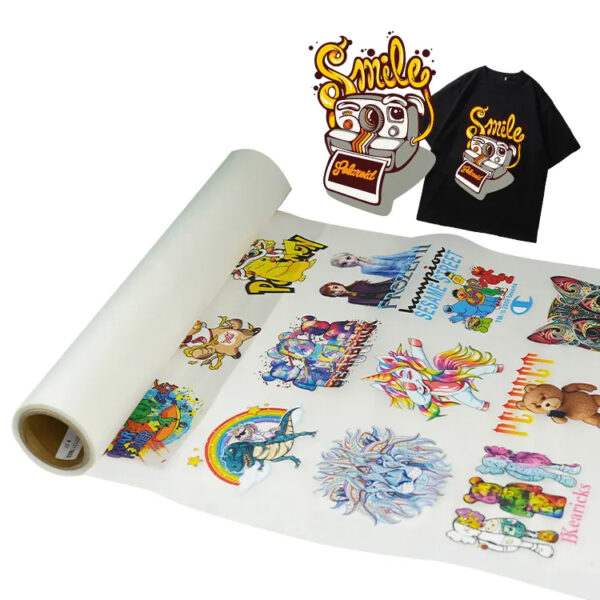
Here’s how I coach wholesale buyers when the clock is tight and the stakes are real—use three evaluation metrics that hold up under pressure. 1) Release consistency: verify hot-peel force variance stays inside a tight band across the roll (no sudden spikes halfway through). 2) Static and stacking: ask for COF targets and anti-block treatments; confirm no sticking after 200 stacked sheets at room humidity. 3) Moisture resilience: check packaging, desiccant count, and re-wind tension so powder doesn’t clump after transit across, say, the I-10 in August. Hold up. If a supplier can’t show data—or won’t—move on. That simple discipline has saved my team thousands in reprints and kept clients calm when runs doubled overnight. For a grounded view on materials and specs without the sales fluff, I often compare notes with Xinflying and keep dialing in what actually works on press.